Basketball Rules Explained for Beginners
Basketball is one of the most popular sports in the world, but its rules can seem confusing when you watch a game for the first time. Players move quickly, teams switch between offense and defense, and referees frequently stop play for different violations and fouls.
The good news is that you do not need to memorize every rule to understand basketball. Once you learn the basic concepts, such as scoring, dribbling, traveling, fouls, possession, and the shot clock, watching a game becomes much easier and more enjoyable.
This beginner-friendly guide explains the most important basketball rules in simple language.
What Is the Objective of Basketball?
The main objective of basketball is simple: score more points than the opposing team before the game ends.
Two teams compete against each other, with each team attempting to put the ball through the opponent’s basket while protecting its own basket.
A standard basketball team has five players on the court at one time. Players can pass, dribble, shoot, and move around the court while trying to create scoring opportunities.
Although basketball has many detailed rules, most of the game revolves around three basic ideas:
- Move the ball legally.
- Prevent the other team from scoring.
- Score more points than the opponent.
How Basketball Scoring Works
Basketball uses different point values depending on where a shot is taken.
One Point
A free throw is worth one point.
Free throws are awarded after certain types of fouls, giving a player an uncontested opportunity to shoot from the free-throw line.
Two Points
A regular field goal taken from inside the three-point line is worth two points.
Players frequently score two-point baskets through jump shots, layups, floaters, and shots near the basket.
Three Points
A shot taken from behind the three-point line is worth three points.
Three-point shooting has become an important part of modern basketball because successful long-range shots can quickly change the score of a game.
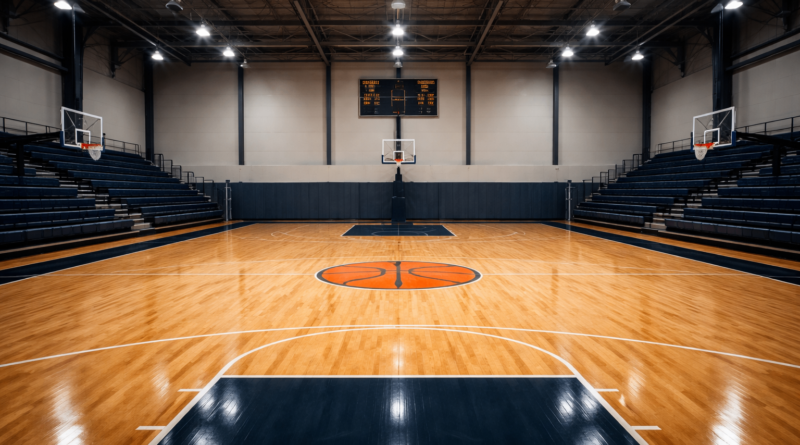
Understanding the Basketball Court
Knowing the basic areas of the court can make the rules easier to understand.
Important areas include:
- Basket: The hoop players attempt to score through.
- Three-point line: Shots made from beyond this line are worth three points.
- Free-throw line: Players shoot free throws from this area.
- Paint: The rectangular area close to the basket.
- Baseline: The boundary line behind the basket.
- Sideline: The boundary running along the length of the court.
- Half-court line: Divides the court into two halves.
The exact court dimensions can vary depending on the league and level of competition.
The Traveling Rule
Traveling is one of the most common violations beginners notice.
A player cannot move around the court while holding the ball without legally dribbling it.
When a player stops dribbling and establishes a pivot foot, that foot generally cannot be lifted and returned to the floor before the ball is released, subject to the applicable rules.
If a player takes illegal steps while controlling the ball, the referee may call traveling.
Simple Example
Imagine a player receives a pass and takes several steps toward the basket without dribbling. That movement can result in a traveling violation.
Understanding the relationship between dribbling, stopping, and pivoting is one of the easiest ways to recognize traveling.
What Is a Double Dribble?
A double dribble occurs when a player stops their dribble and then starts dribbling again, unless an exception applies.
For example:
- A player dribbles toward the basket.
- The player stops and gains control of the ball.
- The player starts dribbling again.
- The referee calls a violation.
Players must therefore make decisions carefully when ending their dribble.
Carrying or Palming the Ball
Players must maintain a legal dribble.
A carrying violation can occur when a player places their hand underneath or otherwise significantly changes the relationship between the hand and ball in a way that gives the player an illegal advantage.
Good ball handlers keep the ball under control while maintaining a legal dribbling motion.
The 24-Second Shot Clock
In many forms of organized basketball, teams have a limited amount of time to attempt a shot.
In the NBA, the shot clock is 24 seconds.
This rule prevents teams from holding the ball indefinitely and encourages an active style of play.
If a team fails to make a valid shot attempt within the required time, possession may be awarded to the opposing team.
Different leagues and competitions can use different shot-clock rules, so beginners should always consider which competition they are watching.
The 8-Second Rule
In the NBA, an offensive team generally has 8 seconds to move the ball from its backcourt into the frontcourt.
This rule encourages teams to advance the ball instead of spending too much time in their own half.
If the team fails to cross the midcourt line within the required time, the opposing team can receive possession.
The Backcourt Violation
Once an offensive team has established control of the ball in the frontcourt, it generally cannot intentionally return the ball to the backcourt and be the first team to touch it there.
This is known as a backcourt violation.
The rule encourages teams to continue moving toward the opponent’s basket rather than repeatedly retreating after gaining frontcourt possession.
Out-of-Bounds
The basketball court has boundary lines.
A player or the ball is considered out of bounds when the applicable conditions for being outside the playing area are met.
For example, if a player steps on the sideline while holding the ball, possession is normally awarded to the opposing team.
The same basic idea applies when the ball touches the boundary or an object outside the playing area.
Personal Fouls
Fouls are another major part of basketball.
A personal foul generally involves illegal physical contact with an opponent.
Examples can include:
- Illegal pushing
- Holding
- Blocking
- Illegal use of the hands
- Charging
- Certain forms of illegal contact during a shot
Not every physical contact is automatically a foul. Basketball allows some contact, and referees determine whether the contact violates the rules.
Shooting Fouls
A shooting foul can occur when a defender illegally contacts an offensive player during a shooting action.
Depending on the circumstances and whether the shot is successful, the offensive player may receive free throws or other benefits under the applicable rules.
For beginners, the important idea is that defenders must avoid illegal contact that interferes with an opponent’s shooting motion.
Offensive Fouls
Fouls can also be committed by offensive players.
One well-known example is an offensive charge.
A charge can occur when an offensive player illegally initiates contact with a defender who has established a legal guarding position, subject to the specific rules governing the play.
Offensive fouls can result in a change of possession.
Blocking Foul vs. Charging Foul
These two calls can sometimes be difficult for beginners.
A blocking foul generally occurs when a defender illegally prevents or impedes an offensive player’s movement.
A charging foul generally occurs when an offensive player illegally creates contact with a defender who has established a legal position.
The referee must evaluate the position of the players, the timing of the contact, and other circumstances surrounding the play.
Free Throws
Free throws give players an opportunity to score without defensive interference.
The shooter stands behind the free-throw line and attempts to make the shot.
Free throws are especially important because they can provide points when the clock is stopped and the defense cannot directly contest the shot.
Players must also follow specific free-throw rules concerning positioning and movement around the lane.
The Three-Second Rule
One of the rules beginners often hear about is the three-second violation.
In the NBA, an offensive player generally cannot remain in the opponent’s restricted area of the lane for more than three consecutive seconds while their team controls the ball in the frontcourt, subject to the rule’s exceptions.
This rule prevents offensive players from simply standing near the basket for an extended period.
There are also defensive three-second rules in some competitions, including the NBA, so the exact application depends on the league.
Jump Ball and Possession
A basketball game needs rules for determining possession when players compete for the ball.
A jump ball can be used in certain situations, while many leagues use an alternating-possession procedure for some held-ball situations after the opening tip.
The exact possession rules vary by competition.
This is one reason why watching a specific league regularly helps beginners become familiar with its particular rules.
Substitutions
Basketball allows teams to replace players during stoppages in play according to the competition’s substitution rules.
Coaches use substitutions for many reasons, including:
- Resting players
- Managing fouls
- Changing defensive matchups
- Improving offensive spacing
- Adjusting to the opponent
Because basketball is fast-paced, substitutions are an important part of game strategy.
Timeouts
Teams can use timeouts to stop play and communicate with players.
Coaches may call timeouts to:
- Design an important play
- Organize the defense
- Stop an opponent’s momentum
- Rest players
- Prepare for the final moments of a close game
The number and type of timeouts available can vary between competitions.
How Long Is a Basketball Game?
Game length depends on the league.
For example, NBA games consist of four quarters, with each quarter lasting 12 minutes during regulation play.
International basketball governed by FIBA uses four 10-minute quarters.
College basketball in the United States has different timing rules from professional leagues.
Overtime periods are used when the score is tied after regulation, with the exact overtime format depending on the competition.
Why Basketball Has So Many Rules
At first, basketball rules may seem complicated, but most of them exist to keep the game fair, safe, and competitive.
Rules regulate:
- Player movement
- Ball possession
- Physical contact
- Scoring
- Time
- Court boundaries
- Team behavior
Without these rules, teams could gain unfair advantages by holding the ball indefinitely, making excessive physical contact, or moving illegally.
Common Basketball Violations Beginners Should Know
Here are several violations worth learning first:
Traveling
Moving illegally while controlling the ball without a legal dribble.
Double Dribble
Stopping a dribble and then starting another dribble without an applicable exception.
Carrying
Illegally controlling the ball during a dribble.
Out of Bounds
The ball or player meets the conditions for being outside the playing area.
Backcourt Violation
An offensive team illegally returns the ball to the backcourt after establishing frontcourt control.
Shot Clock Violation
A team fails to make the required shot attempt within the available time.
Learning these violations will make it much easier to follow a live basketball game.
Tips for Beginners Watching Basketball
You do not need to learn every rule before watching your first game.
Start by focusing on a few important things.
First, watch which team has possession.
Second, pay attention to whether players are dribbling legally.
Third, notice when referees stop play.
Fourth, learn the difference between a foul and a violation.
Finally, keep an eye on the scoreboard and shot clock.
After watching several games, many rules that initially seem complicated will become much easier to recognize.
Final Thoughts
Basketball is a fast and exciting sport, and understanding the basic rules can make watching it much more enjoyable.
Beginners should start with the fundamentals: scoring, dribbling, traveling, fouls, free throws, out-of-bounds situations, the shot clock, and possession.
The rules can vary between leagues, so it is important to remember that NBA, FIBA, college, high school, and youth basketball may not use exactly the same regulations.
Once you understand the basic rules, you can gradually learn more advanced concepts such as defensive schemes, offensive sets, pick-and-roll actions, spacing, transition play, and strategic clock management.
Most importantly, do not worry about learning everything at once. Watch games, pay attention to referee calls, and use each game as an opportunity to learn something new. With time, basketball rules become much easier to understand—and the strategy behind the game becomes even more interesting.