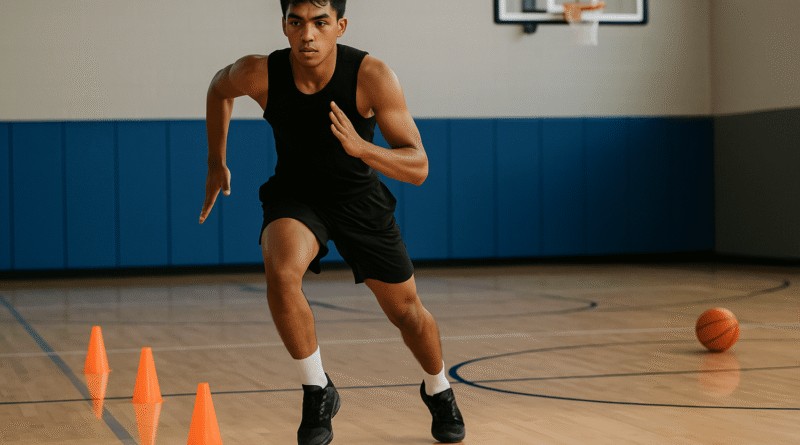
Best Basketball Drills to Improve Speed and Agility
Speed and agility are essential skills for basketball players. Whether you’re driving to the basket, defending an opponent, chasing a loose ball, or changing direction during a fast break, quick movement can significantly impact your performance on the court.
While natural athletic ability can be helpful, speed and agility can be developed through consistent training. The right drills improve footwork, reaction time, balance, coordination, and overall athleticism.
This guide explores some of the best basketball drills designed to improve speed and agility for players of all skill levels.
Why Speed and Agility Matter in Basketball
Basketball is a fast-paced sport that requires constant movement.
Players frequently need to:
- Sprint
- Stop quickly
- Change direction
- Jump
- Defend opponents
- React to game situations
Improving speed and agility can help players:
- Create scoring opportunities
- Improve defensive performance
- Enhance court movement
- Increase overall athleticism
- Gain a competitive advantage
These physical qualities are valuable for every position on the court.
Dynamic Warm-Up Before Training
Before performing speed and agility drills, players should complete a dynamic warm-up.
Examples include:
- High knees
- Butt kicks
- Leg swings
- Arm circles
- Walking lunges
A proper warm-up prepares the muscles and joints for intense activity while reducing injury risk.
Agility Ladder Drills
Agility ladders are one of the most popular training tools in basketball.
They help improve:
- Foot speed
- Coordination
- Balance
- Body control
Basic Ladder Run
Run through the ladder as quickly as possible while placing one foot in each square.
This drill develops quick and precise foot movement.
In-and-Out Drill
Step both feet inside a square and then outside before moving forward.
This exercise improves coordination and lateral movement.
Lateral Ladder Shuffle
Move sideways through the ladder while maintaining a low athletic stance.
This closely resembles defensive basketball movements.
Cone Shuttle Runs
Shuttle runs are excellent for developing acceleration and change-of-direction ability.
How It Works
Place cones several meters apart and sprint between them.
Players must:
- Accelerate quickly
- Stop efficiently
- Change direction rapidly
This drill closely mimics basketball game situations.
Defensive Slide Drill
Defense requires quick lateral movement.
The defensive slide drill helps players improve:
- Lateral speed
- Balance
- Defensive positioning
Instructions
- Assume a defensive stance.
- Slide laterally from one cone to another.
- Avoid crossing your feet.
- Maintain proper posture throughout the drill.
Consistent practice improves defensive effectiveness.
T-Drill
The T-Drill is widely used to measure agility.
Setup
Arrange cones in a T-shaped pattern.
Players:
- Sprint forward.
- Shuffle sideways.
- Change directions.
- Backpedal to the starting point.
This drill develops multiple movement patterns used during games.
Zigzag Cone Drill
Basketball players frequently change direction while dribbling and defending.
Benefits
The zigzag drill improves:
- Agility
- Acceleration
- Body control
- Coordination
Players sprint from cone to cone while making sharp directional changes.
Sprint and Backpedal Drill
This drill develops both offensive and defensive movement skills.
Instructions
- Sprint forward to a cone.
- Backpedal to the starting line.
- Repeat multiple times.
Benefits include:
- Faster transitions
- Improved conditioning
- Better defensive recovery
Reaction Ball Drill
Basketball often requires instant reactions.
A reaction ball bounces unpredictably, forcing players to react quickly.
Benefits
This drill improves:
- Reaction time
- Hand-eye coordination
- Athletic awareness
Quick reactions are valuable in both offensive and defensive situations.
Box Jump Training
Explosive power contributes to both speed and agility.
Box jumps help develop:
- Leg power
- Vertical leap
- Explosiveness
Instructions
- Stand in front of a sturdy box.
- Jump onto the platform.
- Land softly.
- Step down and repeat.
Box jumps are commonly used by elite basketball players.
Jump Rope Drills
Jump rope training improves:
- Footwork
- Coordination
- Endurance
- Rhythm
Many professional players use jump rope workouts to enhance movement efficiency.
Variations
Try:
- Single jumps
- High-speed jumps
- Alternating foot jumps
- Double-under attempts
These exercises challenge different aspects of athletic performance.
Closeout Drill
Closeouts are an important defensive skill in basketball.
How It Works
Players sprint toward a shooter and quickly transition into a defensive stance.
This drill develops:
- Speed
- Balance
- Defensive awareness
- Reaction ability
Effective closeouts can significantly improve team defense.
Suicide Runs
Suicide runs are one of the most demanding conditioning drills in basketball.
Instructions
Players sprint to multiple court lines and return to the starting position.
Benefits include:
- Improved speed
- Better endurance
- Increased mental toughness
- Enhanced conditioning
Many teams use suicide runs during preseason training.
Lateral Cone Hops
Lateral movement is critical for basketball success.
Benefits
Lateral cone hops improve:
- Agility
- Explosive power
- Balance
- Coordination
Players jump side to side over small cones while maintaining control.
Mirror Drill
The mirror drill is excellent for developing defensive reactions.
Instructions
One player leads while the other mirrors their movements.
Benefits include:
- Faster reactions
- Improved defensive footwork
- Better anticipation
This drill closely simulates real-game defensive situations.
Dribbling Speed Drills
Combining ball handling with speed training is highly beneficial.
Examples include:
- Full-court speed dribbling
- Cone dribbling courses
- Zigzag dribble sprints
These drills improve both athleticism and basketball-specific skills.
Interval Sprint Training
Basketball consists of repeated bursts of high-intensity effort.
Interval training helps players prepare for these demands.
Example Workout
- Sprint for 20 seconds
- Rest for 20 seconds
- Repeat several rounds
This improves both speed and recovery ability.
Importance of Recovery
Training intensity should be balanced with proper recovery.
Recovery strategies include:
- Hydration
- Stretching
- Quality sleep
- Mobility work
- Proper nutrition
Recovery helps athletes maintain performance and reduce injury risk.
Common Mistakes During Agility Training
Players should avoid:
- Poor technique
- Skipping warm-ups
- Excessive training volume
- Ignoring recovery
- Sacrificing control for speed
Quality movement is more important than simply moving fast.
Building a Complete Speed and Agility Program
An effective basketball training program should include:
- Sprint drills
- Agility exercises
- Strength training
- Plyometrics
- Recovery sessions
Combining these elements helps maximize athletic development.
Final Thoughts
Speed and agility are crucial components of basketball performance. Drills such as agility ladder exercises, defensive slides, shuttle runs, cone drills, jump rope workouts, and reaction training can help players move more efficiently and react more quickly on the court.
By practicing these exercises consistently, athletes can improve their footwork, acceleration, defensive ability, and overall game performance. Whether you’re a beginner or an experienced player, developing speed and agility can give you a significant advantage in today’s fast-paced game of basketball.